- Introduction: The Man Who Gave Ordinary Investors a Fair Deal
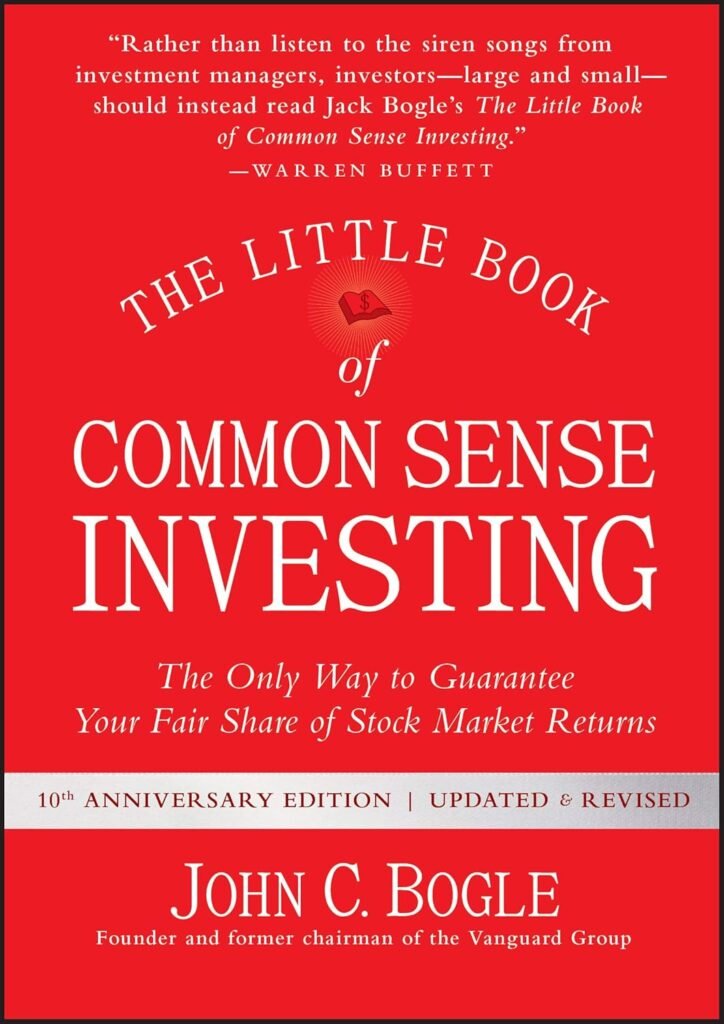
If Benjamin Graham taught investors how to think, and Morgan Housel taught them how to behave, then John C. Bogle taught them what to actually do. His 2007 classic, The Little Book of Common Sense Investing, is arguably the most important practical investing book ever written for the ordinary person.
Bogle was not a Wall Street trader chasing the next multibagger. He was the founder of Vanguard and the inventor of the world’s first index mutual fund — a man who spent his entire career fighting for the small investor and against the high fees of the financial industry. His central message is radical in its simplicity:
“Don’t look for the needle in the haystack. Just buy the haystack.”
In other words: stop trying to pick winning stocks or winning fund managers. Instead, buy the entire market through a low-cost index fund, hold it forever, and let the magic of long-term compounding — undiluted by fees — do the work. This article distills Bogle’s timeless wisdom into its core lessons.
- The Central Thesis: Owning the Whole Market
Bogle’s argument begins with an elegant, almost mathematical truth about investing as a whole.
The stock market, in aggregate, delivers a certain return over time — the collective return of all businesses. All investors, as a group, are the market. Therefore, before costs, the average investor must earn exactly the market’s return. It cannot be otherwise.
But here’s the catch: investing is not free. Once you subtract the costs — management fees, trading commissions, taxes, and hidden expenses — the average investor must, by simple arithmetic, earn less than the market return.
The Grim Arithmetic: Gross market return, minus the costs of investing, equals the net return actually delivered to investors. The more you pay the croupiers of the financial system, the less you keep.
An index fund simply buys and holds every stock in a market index (like the Nifty 50 or the S&P 500), in the correct proportions, and almost never trades. Because it requires no expensive research team and no frantic buying and selling, its costs are minuscule. The result: an index fund captures nearly the entire market return, while the average active fund — after its high fees — captures noticeably less.
- The Tyranny of Costs: The Silent Wealth Killer
If there is one lesson Bogle hammers home relentlessly, it is the devastating long-term impact of costs. Most investors dramatically underestimate this, because a “small” annual fee sounds harmless.
It is not.
Consider two investors, each earning an 8% gross annual return over 40 years. One pays 0.1% in costs (an index fund); the other pays 2% (a typical active fund).
- The low-cost investor keeps 7.9% per year.
- The high-cost investor keeps 6% per year.
That gap of less than 2% per year seems trivial. But compounded over four decades, the high-cost investor ends up with roughly half the final wealth of the low-cost investor. Nearly half of a lifetime’s potential gains — silently handed over in fees.
Bogle’s warning: “In investing, you get what you don’t pay for.” Costs are the one variable in investing you can control with certainty, and controlling them is the single most reliable way to improve your returns.
The lesson for the Indian investor is direct: always check the expense ratio of any mutual fund, favour direct plans over regular plans (which carry higher commissions), and treat every fraction of a percent as money stolen from your future compounding.
- Why Most Active Managers Fail to Beat the Market
The natural objection is: “But surely a skilled professional fund manager can beat the market?” Bogle marshals decades of data to show why, for the vast majority, the answer is a stubborn no.
The reasons are structural, not personal:
- Costs: Active funds charge far more, and that head start is nearly impossible to overcome year after year.
- The zero-sum problem: For every manager who beats the market, another must lag it. Active management is a loser’s game in aggregate once fees are counted.
- Survivorship bias: Poorly performing funds are quietly closed or merged, so the funds that survive create an illusion that active management works better than it does.
- Reversion to the mean: Last year’s star fund is very often next year’s laggard. Chasing “hot” past performance is one of the most common and costly mistakes investors make.
Bogle’s evidence showed that over long periods, the overwhelming majority of actively managed funds underperform a simple, low-cost index fund. And the tiny minority that outperform are almost impossible to identify in advance.
Picking the rare winning manager ahead of time, Bogle argued, is like finding a needle in a haystack — so why not just buy the haystack and be guaranteed the market’s return?
- The Enemy Within: Emotion and the “Relentless Rules of Humble Arithmetic”
Bogle recognized, much like Morgan Housel, that the biggest threat to an investor’s success is often the investor themselves. Even those who own index funds frequently sabotage their own returns.
The culprit is emotional, performance-chasing behavior:
- Buying more when markets are euphoric and prices are high.
- Panic-selling when markets crash and prices are low.
- Jumping between funds chasing recent performance.
This creates a painful gap: the return the fund earns versus the (lower) return the investor actually earns because of poor timing. Bogle’s antidote is discipline and simplicity — buy the market, and then have the emotional fortitude to do nothing.
“The stock market is a giant distraction from the business of investing.” — John Bogle
This connects beautifully to the SIP philosophy we champion in our Investment Basics section: by investing a fixed amount regularly and automatically, you remove emotion from the equation entirely and let time, not timing, build your wealth.
- Simplicity Beats Complexity
A recurring theme in Bogle’s philosophy is that the financial industry profits from complexity, while investors profit from simplicity.
The industry has every incentive to sell you complicated, expensive products — exotic funds, structured products, frequent trading strategies — because complexity justifies high fees. Bogle cuts through all of it with a proposition that sounds almost too easy:
- Own a broad, low-cost index fund.
- Diversify across the entire market automatically.
- Keep costs to the absolute minimum.
- Hold for the long term.
- Ignore the noise.
That’s it. There is no secret formula, no genius stock pick, no perfect entry point. The “common sense” in the title is precisely this: the best investment strategy is not clever — it is boringly, reliably simple. And its very simplicity is what makes it so hard for the industry to sell, and so easy for the disciplined investor to profit from.
- The Power of Long-Term Compounding
Bogle was a passionate evangelist for the long term. He drew a sharp distinction between two forces:
- The magic of compounding returns: Over decades, reinvested returns snowball into enormous wealth — the same principle we detail in our Basics articles on compounding and SIPs.
- The tyranny of compounding costs: Over those same decades, fees also compound — but against you, silently eroding that snowball.
The investor’s job is to maximize the first force and minimize the second. Time in the market is the great multiplier, and low costs ensure you keep the full benefit of that time.
Bogle urged investors to think in decades, not days. The daily gyrations of the market are, in his words, mostly “noise and emotion.” What matters is the patient, decades-long accumulation of business value.
This is why he was so scornful of frequent trading. Every trade incurs costs and taxes, and each one is a bet against the market’s long-term upward trend — a trend that, historically, has rewarded those who simply stayed invested.
- Bogle’s Timeless Rules for Investors
Throughout the book, Bogle offers practical maxims that serve as a checklist for the common-sense investor:
- Minimize costs above all. The lower your costs, the greater your share of the market’s return.
- Buy the whole market. Broad diversification eliminates the risk of betting on individual stocks or sectors.
- Beware of the “experts.” Forecasts, hot tips, and market predictions are mostly noise designed to make you trade.
- Don’t chase performance. Yesterday’s winners are frequently tomorrow’s losers.
- Stay the course. Once you’ve set a sensible plan, the hardest and most important thing is to stick to it through every boom and bust.
- Time is your friend; impulse is your enemy. Let compounding work, and resist the urge to tinker.
- Applying Bogle in the Indian Context
While Bogle wrote primarily about the American market, his principles translate directly for Indian investors — and the Indian index-fund ecosystem has matured significantly.
Practical takeaways for our readers:
- Consider low-cost index funds tracking the Nifty 50, Nifty Next 50, or broader indices as a core, foundational holding — echoing the “start with an index fund” advice from our Mutual Funds vs Stocks piece.
- Always choose Direct plans over Regular plans to eliminate distributor commissions and lower your expense ratio.
- Scrutinize the expense ratio of every fund you own. In index funds, a lower expense ratio is one of the few near-certain predictors of better relative performance.
- Automate via SIP to enforce discipline and remove the temptation to time the market.
- Understand the debate: Indian markets have historically offered more scope for active managers to outperform than highly efficient Western markets, so many Indian investors blend a low-cost index core with a smaller satellite of actively managed or direct-equity holdings — a nuance worth researching for your own situation.
- Criticisms and Nuances
No investment philosophy is beyond debate, and intellectual honesty requires acknowledging the counterarguments:
- Market efficiency varies. In less-efficient or emerging markets, skilled active managers have historically had more room to add value than in the ultra-efficient US market Bogle studied.
- Index concentration risk. When a handful of giant companies dominate an index, “buying the market” can mean unknowingly concentrating in a few names — a live concern in today’s technology-heavy indices.
- It requires patience most people lack. The strategy is simple but not easy; its success depends entirely on the investor’s emotional discipline to hold through downturns.
Bogle himself would likely respond that these nuances don’t overturn the core arithmetic: costs are certain, outperformance is not, and for the vast majority of ordinary investors, the low-cost index remains the smartest default.
- Actionable Checklist for Readers
- Audit the expense ratio of every fund you currently own — are you overpaying?
- Switch any Regular plans to Direct plans to cut hidden costs.
- Consider anchoring your portfolio with a low-cost, broad-market index fund.
- Set up an automated SIP and commit to it regardless of market mood.
- Stop chasing “top-performing” funds; focus on cost and consistency instead.
- Adopt a decades-long mindset — measure success in years, not days.
- Above all: once your plan is set, stay the course.
- Conclusion: The Quiet Genius of Common Sense
The Little Book of Common Sense Investing endures because it strips investing down to its irreducible truths. In a world of dazzling complexity, screaming headlines, and endless products promising to beat the market, Bogle’s message is a calm, powerful counterpoint: you don’t need to beat the market — you just need to be the market, at the lowest possible cost, for the longest possible time.
He didn’t just write about this philosophy; he built an entire company, Vanguard, to deliver it — and in doing so, he saved ordinary investors untold billions in fees. His legacy is not a clever trick, but a fair deal for the common investor.
For anyone building long-term wealth, Bogle’s wisdom is the practical foundation upon which the lessons of Graham, Kiyosaki, and Housel all rest. Master your costs, own the market, and stay disciplined — and you will very likely outperform the vast majority of “sophisticated” investors who never learned this simple truth.
Highly recommended: This synopsis covers the main ideas, but the book’s data, charts, and Bogle’s own passionate voice are best experienced firsthand.
Buy and read the full book for a richer understanding and to transform your own relationship with investing.